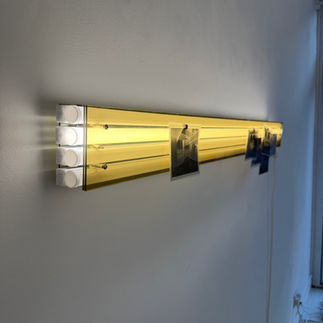
Knew I had to see this show as soon as the electric privacy film showed up on my feed. Ted Le Swer seamlessly captures the corporate dissociation which seems to be a hallmark of whatever movement is brewing currently, at least in London and New York. Office-chic-girl-boss culture has given way to something more tepid: an aestheticization (if not romanticization) of the daily slog, of the blank space, of the empty gaze, of the 6400 Kelvin-LED-lit room.

Le Swer mixes the aesthetics of corporate storage and institutional infrastructure to capture the time-adjacent pit of his former work. Through a mix of digital and analogue techniques, Le Swer abstracts his works from banal inspirations including an office couch and in-wall fan.
I have been dwelling on the concept of an art show in a corporate office for the past couple months. My studio while in the Graduate Diploma at the RCA was in White City, in an office complex. Every day, when I went in, I felt like I was undercover: walking from the Central Line station to the town (c), alongside all these people with bug-shell-looking backpacks and shiny shoes, and nobody knew that I was really on my way to, like, pour lumpy cement on top of a shitty painting.
I spoke about this with Ken Hollings a couple months ago, when we were discussing the potential closing of the campus in White City. He agreed that the closing is indeed a shame: "I always tell my students, when they complain about the programme being in White City, I say 'don't you know you're making work for the real world? you have to make work in the real world!'" (I am certainly taking some liberties here with this quotation, but that was the gist of the statement at least).
The White City development creates an environment similar to Canary Wharf, with all these magnificent glass buildings and in-ceiling bright-white lights. The corporate campus contains these large outdoor commons, where the grass is so green, but it feels almost illegal to walk on it (and god forbid you sit down!). In my research, in an attempt to figure out what exactly I find so compelling about places like these, I found Marc Augé's work on the "Non-Place". I was particularly interested in his definition of supermodernity through an excess of time (history accelerates), space (globalization compresses distance), and individuality (constant self-focus). I hosted a little salon for my friends to discuss a portion of the reading (which I've attached below for anyone interested) but we drank too much wine and didn't really established anything of import.
And then there are studios like at the Koppel Project or Set, in these massive office buildings which have largely sat empty since Covid. These constructions reminds me of Talking Heads' (Nothing But) Flowers. How wonderful, that a former business archipelago should develop into a city of young creatives! Isn't it? But like the iconic Naked album song, I can't help but feel dissatisfied with the state of this development - and it's not just the realization of how many other emerging artists there must be in London, that they can fill up multiple office complexes.
No, the feeling I get when I think of these art office complexes resembles something more of the perception of a phantom limb: in some strange way I miss, for lack of a better term, the structure of urban corporate culture. I've never seen Sex in the City, and I only got one episode into Girls before getting too scared to watch anymore (a 25 year old! Doing unpaid creative labor! In a megacity! Could you imagine?). And yet, I am deeply saddened by the creeping extinction of the move-to-the-city-get-a-job-work-your-way-up culture of the 90s and early 2000s, as thought its something I've experienced. I have written about this feeling of eerie familiarity before, discussing my flashlight-activated screenprints of 80s New York, as well as my Banker's Box work, about media and memory (succinctly developed in Alison Landsberg's Prosthetic Memory), and I suppose a large part of my work is exploring how display technologies allow for the inheritance of memory.
Is this part of the reason Le Swer's aesthetic of dissociative corporate culture resonates so deeply? It's not just the office, it's the empty office, which only feels so empty because it's supposed to be full, and, at least for the people who came of corporate age in the time after coronavirus, we only know it's supposed to be full because of these media depictions which have sold us the capitalism of the 80s and 90s. We were promised that the economy would keep growing, that history was over, and that we, too, would get to experience water cooler conversation and ripped pantyhose and the click-clacking of expensive leather shoes down a linoleum hall. And now we've been left, alone, in the office, and the lights are still working and so is the fan and we're supposed to be working, too, but there's not really anything to do anymore, is there...
Le Swer's modification of the actual space of the exhibition illuminates something novel about this aesthetic: its boredom. You don't think about a black void enveloping the office couch if you're running around from meeting to meeting or trying to fix up a deliverable for a client. This is, in a way, a resistance to the space constant transit that Augé suggests as a hallmark of the non-place, and it is so very hard to be bored these days. I wonder how Le Swer achieved it; I also wonder what sort of building his studio is in. I will write to him and ask him, soon, I think.